
Ridgecrest City Directory Shelves
Kern County Library and the California State Library hold the strongest Ridgecrest city directory material. Neither offers a long Polk series. The Beale Local History Room holds Kern County telephone directories dating to 1940. It also keeps Bakersfield city directories from 1899 and donated yearbooks, chiefly from the 1960s and 1970s. The room rounds that out with Ridgecrest newspaper microfilm and more than 900 local-history vertical-file subjects. A telephone volume may list Ridgecrest itself or the wider Indian Wells Valley. Staff can confirm the exact issue before you travel. Ask first, because the label on the spine rarely tells the whole story.
| Collection | Years | Publisher | Where Held | Access |
|---|---|---|---|---|
| Kern County telephone directories | 1940 to present range stated | Issue-level publisher not verified | Beale Local History Room | Noncirculating; call ahead |
| Bakersfield city directories | 1899 onward stated | Publisher sequence not listed | Beale Local History Room | County context, not Ridgecrest proof |
| Ridgecrest newspapers | Exact titles and years not listed online | Local titles not enumerated | Beale microfilm | Staff-assisted research |
| Kern school and college yearbooks | Mainly 1960s to 1970s | School or college issue | Beale Local History Room | In-room identity leads |
| State Library directory databases | Exact Ridgecrest results require a query | Varies by catalog record | California State Library | Search “Kern” and “Ridgecrest” |
The gaps carry evidence too. No official catalog publishes a first or last year for a Ridgecrest Polk run, a reverse-section sequence, or a publisher list. The State Library's guide names two specialized databases but stops short of enumerating local holdings. A missing result can mean several things. It may reflect a catalog label, a volume gap, a broader China Lake or Indian Wells Valley title, or a collection open only in person. Treat every empty result as a question to ask staff, not a final answer.
Ridgecrest Directory Help at Beale
Beale Local History Room sits on the second floor of the main library at 701 Truxtun Avenue in Bakersfield. Nothing circulates from the room. Its shelves hold telephone directories, newspapers, yearbooks, pamphlets, newsletters, and vertical files, with some materials reaching back into the 1800s. Staff will take obituary, article, and research requests. That is a real help when a trip from Ridgecrest is not practical.
Phone ahead at 661-868-0771, since access to the room depends on staff availability. The Ridgecrest Branch at 131 E. Las Flores Avenue connects locals to the county catalog and electronic resources. The deeper telephone and microfilm collections live at Beale, though. When you contact the library, ask for the exact volume. Also request its place label, the call number, and whether a reader or a staff search is required.
The Beale Local History page lists the local-history holdings. It also explains how to submit a research request.
Search Two Ridgecrest Catalog Paths
The California State Library's Kern research guide points genealogists to a City Directory database. It also offers a separate Telephone Book database. Search "Kern" first. Then try "Ridgecrest" and "China Lake." Also try "Indian Wells Valley" and "Inyokern." A catalog record may sit under the county, the publisher, a military community, or a broader place name rather than the current city. The guide is a search method, not proof that a particular Ridgecrest volume exists. Exact publisher, year, and reverse-section claims need the catalog result or staff confirmation. FamilySearch adds land, probate, court, vital, cemetery, and genealogy collections. Images there may require a free account, a FamilySearch Center, or an affiliate library. Verify the collection title and film details. Do this before citing any digitized run. Use the California State Library Kern research guide to test both directory databases.
Read a Ridgecrest City Directory Entry
No official digitized source publishes an actual Ridgecrest volume page. The field list describes documented directory and telephone-book conventions, not a claimed local transcription. Copy the entry exactly as printed. Then check the volume's front-matter abbreviation key. Initials, spouse notes, business lines, and address marks can quietly change what a name seems to say.
| Name | Surname, given name or initial, and sometimes a spouse. |
|---|---|
| Occupation | A directory occupation or workplace field when that volume prints one. |
| Address | House number and street, with volume-specific residence or boarding marks. |
| Owner or renter mark | Some conventional city directories use a symbol; confirm it in that volume. |
| Widow notation | A note such as “wid” can be a genealogy clue, subject to the key. |
- Criss-cross section
- A street-order section that may sort listed subscribers by street and house number.
- Householder index
- A name-based finding aid for people associated with an address or household entry, when the volume provides one.
- Abbreviation key
- The volume’s own guide to shortened occupations, family notes, address marks, and symbols. Read it before interpreting a line.
Ridgecrest Reverse Listings Need Proof
A reverse or criss-cross directory turns a street and house number into a listed subscriber. That makes it valuable for an old address. The subscriber is not always the owner, though. It may not cover every adult or every person who stayed there. No accessible catalog lists a Ridgecrest reverse run. Ask Beale or the State Library before assuming one sits on the shelf. When a reverse section exists, copy the address, name, exchange, and year. Check the alphabetic section too. Compare the prior and next volumes. Bridge any gap with a deed, census schedule, obituary, or newspaper. A first appearance may mark a move, a new phone, a directory expansion, or a new listing rule. A disappearance has just as many explanations.
Ridgecrest Directory Gaps and Federal Context
Ridgecrest's China Lake history can leave a gap between community life and ordinary local directories. A person may surface in a newspaper. Museum publications, base or school material, and civilian filings can also carry names. Federal personnel details stay outside any public city directory. Use the Maturango Museum and China Lake Museum for community context. Neither is a personnel roster. If a family-history question reaches a federal case, PACER is a separate federal docket system. It is not a city directory. A same-name docket proves no Ridgecrest connection. Compare district, case role, date, and co-parties before following that branch. PACER belongs in its own record category, well apart from directory work.
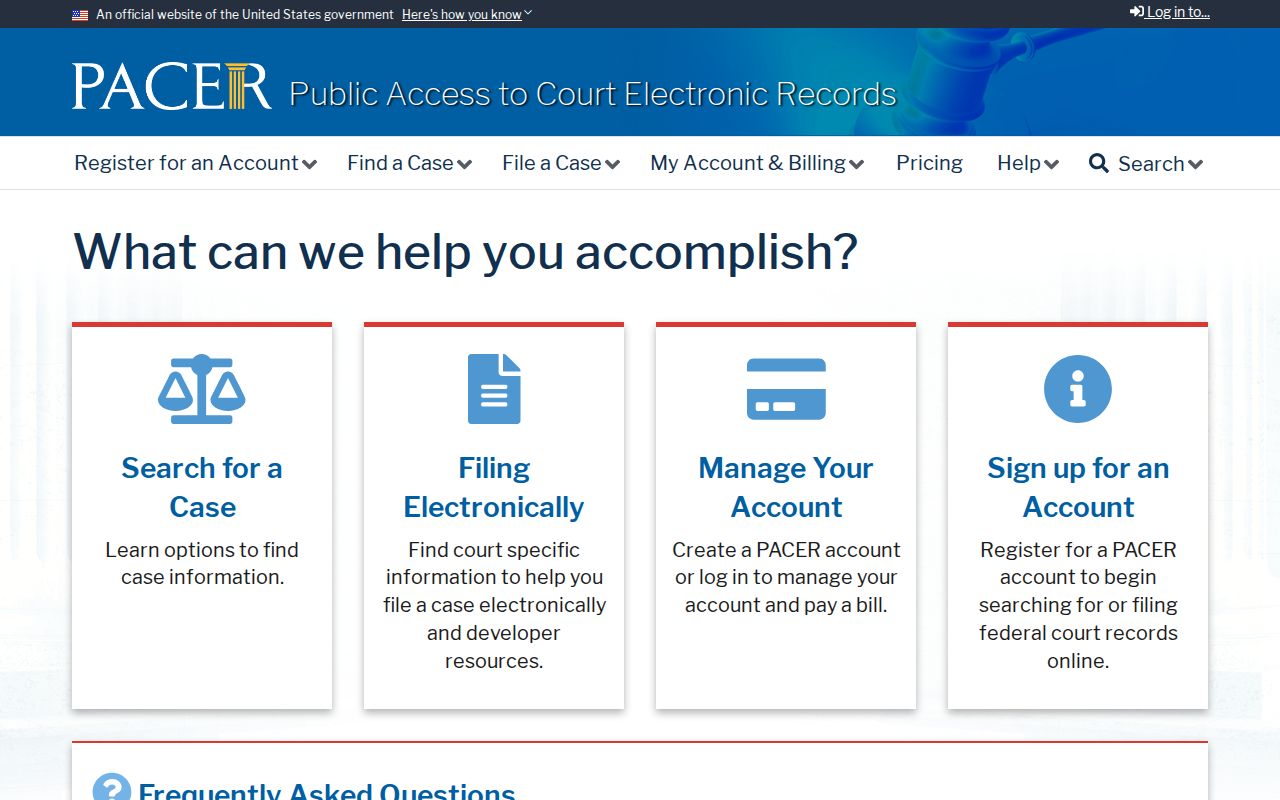
The federal search page marks the line between a historical directory entry and a separate court record.
Trace Ridgecrest Families Across Years
Think of a Ridgecrest city directory as a snapshot with a date on it. Each volume fixes a name to a street for one year. Pair an entry from near the public 1950 census with deeds, newspapers, and election records. Later city files help too. Together they let you watch a household shift over time. Keep the name and the address as separate notes. A listed subscriber hints at a household. Only the census or a second source gives you ages, relationships, and occupation.
- Find the first appearance under the surname, given name, initial, or known former name.
- Copy each address and compare the next available volume, noting a move or a new street label.
- Read the volume’s criss-cross section, if present, to test the address and nearby listed entries.
- Pair the closest directory snapshot with the 1950 census and compare names, ages, relationships, and occupations.
- Close the trail with Ridgecrest newspaper microfilm, an obituary request, cemetery material, probate, or a deed.
A name that vanishes from one volume rarely tells the whole story. The person may have moved or died. They may have dropped a listed number, or an editor simply skipped them. Some directories switched community labels. Rules varied from year to year. Never assume a family left town without dated proof. The Beale Genealogy Room holds census microfilm through 1920 and offers volunteer orientation. From there, work forward through the public 1950 census and later local records.
Ridgecrest Yearbooks Fill Directory Gaps
Telephone books leave classmates and clubs vague. Yearbooks fix that. Beale's donated yearbooks reconnect students, teachers, and community groups with faces and names. Most come from the 1960s and 1970s. Ridgecrest newspaper microfilm adds obituaries, marriage notices, school lists, property items, and social columns. When a title or year is not digitized, the Local History Room takes article and obituary research requests.
Treat each yearbook entry as a lead rather than a conclusion. Compare the name, class year, activity, address, or relative against another record before trusting it. Maturango Museum and China Lake Museum supply photographs and community context. An exhibit is not a personnel file, though. Funeral-home obituary archives and memorial transcriptions work the same way. They remain leads until an official death record or a custodian confirms the fact.
Search Ridgecrest’s Older Place Names
Place names shift, and a good search reflects that. Ridgecrest grew from the settlement called Crumville. It took shape around the China Lake naval research and test installation before incorporating in 1963. Older records may say Crumville, China Lake, Indian Wells Valley, Inyokern, a precinct name, or a county label. Add those terms beside the surname and street when you search a city directory.
Incorporation splits the shelf, too. A pre-1963 road, permit, election, or land action may sit in Kern County files. It may sit there rather than a Ridgecrest city file. A modern postal city is not a historic jurisdiction. That place-name strategy explains why a county telephone volume can beat a narrow current-city search.
Plan a Ridgecrest Directory Visit
Preparation makes a Beale trip productive. Write down the surname and alternate spellings. Add the street, approximate year, possible community label, and the exact record question. Call ahead. Ask whether the telephone volume, microfilm reel, yearbook, or vertical file is on hand. Ask also whether staff can search it. Materials do not circulate, and staff availability governs access.
Closer to town, the Ridgecrest Branch Library at 131 E. Las Flores Avenue helps with county catalog and e-resource access. The Local History Room and Genealogy Room hold the deeper sources. They include telephone books, newspapers, census microfilm, printed vital books, and volunteers. For an obituary or article request, include a narrow date span and every name variant.
Note: A sound directory result records the volume title, place label, issue date, page, exact entry, and abbreviation key.