
Ridgecrest Sources for Past Residents
A past-resident search needs an era map. The current assessor can identify the parcel and annual GIS snapshots can show boundary or attribute changes. The recorder’s deed chain reaches back through Kern’s jurisdictional history, but its online cutoff is not published. Telephone directories and reverse sections are available only where the exact local volume is verified. Census schedules, permits, newspapers, obituaries, and probate add household or life-event evidence.
| Source | Years It Covers | Where Held | What It Shows |
|---|---|---|---|
| Kern Recorder deed index | Kern series from 1866; online cutoff not published | Recorder counter, books, and index | Grantors, grantees, legal descriptions, instruments |
| Kern GIS final editions | 2004 to present | Kern Assessor GIS | Parcel boundaries and attribute snapshots |
| Kern telephone directories | 1940 to present range stated; local gaps need checking | Beale Local History / State Library | Listed subscriber and address clues |
| Federal census | Public through 1950 | NARA, FamilySearch, libraries | Enumerated household, relationship, age, occupation |
| Ridgecrest permits and code files | Digital start not published | City Clerk and departments | Work date, site, applicant, contractor, owner fields |
| Newspapers, obituaries, probate | Exact local runs vary | Beale and Kern Superior Court | Life events, heirs, notices, address-era clues |
Start with the APN for a current parcel. Use deeds for ownership, GIS for a verified digital chronology, telephone books or census for household layers, and permits or newspapers for dates between transfers. The research does not verify Ridgecrest Sanborn sheets, a citywide renumbering year, or a complete standalone city-directory run. Those are gaps to document, not facts to invent.
Begin Ridgecrest History with the APN
A remembered owner can be wrong, while an APN and legal description give the backward search a stable start. Enter the exact number and bare street name in the Kern Assessor Property Search. Record the APN or ATN, parcel-map link, map-book clue, situs, and any legal or subdivision description. The online result does not show the owner name, so do not treat a blank person field as a missing history.
Use the assessment-roll counter or the Kern Recorder to obtain a named title connection where the record can be released. Keep the situs address, mailing address, and legal description distinct. A parcel split or boundary change may require an assessor map or recorded plat before an older deed can be matched.
Use Ridgecrest GIS Snapshots Back to 2004
Kern Assessor GIS has final annual parcel snapshots archived back to 2004. These editions can help show a boundary, map, use, or assessed-value change between older and newer deeds. Preliminary data may be more current but can include interim boundaries or incorrect values. Hardcopy assessor maps remain the official map source.
Compare the current parcel with the oldest available final edition, then inspect the legal description and recorded subdivision materials. GIS is a chronology aid, not a title record. It can show land changing shape while the person layer stays suppressed.
Annual editions also help with a practical question: whether a later deed still describes the same land. A parcel split, merged boundary, or changed map reference can make a surname search look like a break in ownership. Save the map date and compare the APN, lot or block, and legal description before moving farther back.
Walk Backward Through Kern Deeds
The Kern Recorder does not keep a single property file. Documents are organized by document number and grantor or grantee. Find the current vesting deed or another recent instrument, record its grantee, grantor, date, document number, and legal description, then search the seller as a prior grantee. Match the land and date before repeating the step.
- Use the assessor to capture the APN, map, and legal description without expecting an online owner name.
- Find the current vesting or purchase deed through the Recorder’s party index or counter.
- Search the seller as grantee before that sale and constrain the date range.
- Repeat backward, checking the legal description when the APN or street label changes.
- Move to counter books, microfilm, or older instrument references when the unpublished online cutoff is reached.
- Grantor / grantee
- The grantor transfers an interest; the grantee receives it.
- Chain of title
- The linked sequence of recorded transfers for the same land.
- Legal description
- The formal land description used to match a parcel when a street address changes.
- Enumeration district
- The census area assigned to an enumerator, useful when a historical address is hard to read.
Date Ridgecrest Changes with Permits
City permits and code files can place a repair, addition, inspection, or work description between two title transfers. Request by exact address, APN, permit type, and date range through Ridgecrest City Clerk or the relevant department. The public Form Center is mainly for submitting applications, not for browsing a complete historical address index. Code material can be redacted when disclosure would expose complainant privacy or investigative detail.
A permit names an applicant, owner, or contractor only where the file includes that field. It does not prove who occupied a site. Pair the work date with a deed, newspaper notice, telephone entry, or census record.
Ridgecrest’s Form Center is the local request hub.
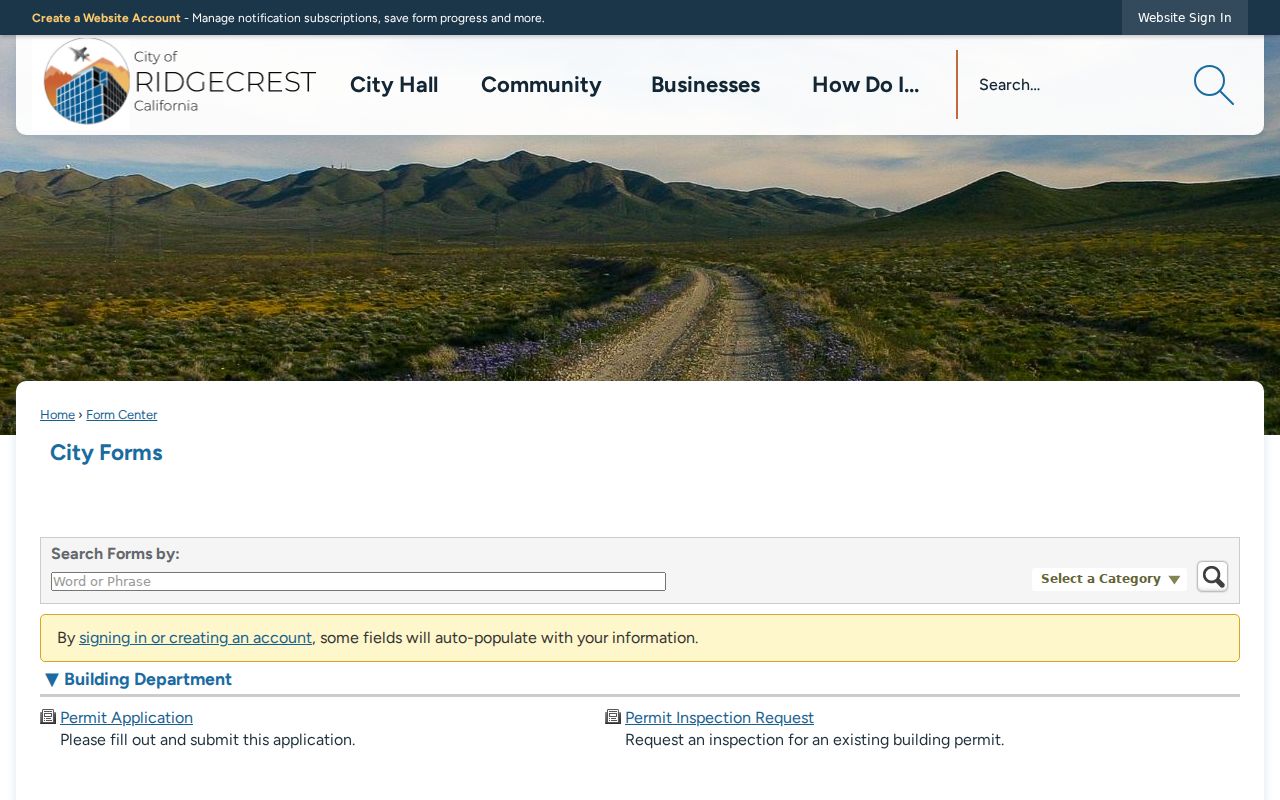
The city form view shows why a focused address and date span are better than a broad request for every record.
Pair Ridgecrest Telephone Books with Census
Telephone books add a listed subscriber and address. The federal census adds an enumerated household, relationships, ages, and occupations. Pair the closest directory entry with the public 1950 census, then move forward through later telephone books, newspapers, deeds, permits, and election material. Military or base residents may use federal property or work contacts, which can thin a city listing.
The exact Ridgecrest reverse-directory run is not verified. Kern telephone books are documented from 1940 at Beale, while the California State Library guide points to a separate Telephone Book database. Use the city directory collections source for shelf and entry-reading method, then keep the address history focused on one parcel.
Past Ridgecrest Households in Context
Owners are only one layer of previous residents. A criss-cross directory, if the volume contains one, may show a listed subscriber. The 1950 census can show the enumerated household. Newspaper social columns, school lists, marriages, and obituaries can connect a name to a date. These sources should be paired, not blended into a claim that one person owned and occupied the property.
The directory collections themselves are described on the Ridgecrest city directory page. Here, use the collection as a time marker: copy the entry, compare the next available issue, and record the first or last appearance. A gap can mean a move, death, unlisted number, skipped volume, or a place-name change.
Lawful use. Previous-resident research in Ridgecrest is for house history, family history, estate work, and personal curiosity. Do not use an address trail to harass, track, intimidate, or harm a living person. California Penal Code §646.9 and Code of Civil Procedure §527.6 define serious limits.
A past household clue becomes stronger when the address, date, source type, and custodian are all written down.
Close Past Residents with Probate
Probate petitions, notices, inventories, and final distributions can name a decedent, petitioner, heir, and service address. Kern Superior Court’s eCourt party search is a starting point, but a complete file may require the clerk and may be sealed or redacted in part. A probate address can be historical or a service address, so it should not be treated as a current location.
Obituary and cemetery records can explain why a directory entry stops. Beale accepts obituary and article research requests and holds Ridgecrest newspaper microfilm. Funeral-home archives and memorial transcriptions are useful leads, but an official death record or court file is the custodian-level check.
For an heir question, compare the probate petition with the deed’s legal description and the obituary’s family names. A petition may list a service address rather than the house being studied. The address is strongest when its date fits the transfer chain and the family link appears in another source.
Record Ridgecrest History Gaps
No documented citywide Ridgecrest renumbering year was found. The larger continuity problem is jurisdiction and place name: Crumville, Ridgecrest, China Lake, Indian Wells Valley, Inyokern, and China Lake Acres can appear in different records. Use historical maps and legal descriptions rather than assuming a modern postal street label existed in an older source.
No verified Ridgecrest Sanborn sheet or exact standalone city-directory publisher sequence was located. A careful previous-residents search states that limit, then uses the documented telephone, newspaper, deed, GIS, census, permit, and probate paths around it.
Ridgecrest’s incorporation in 1963 is itself a useful boundary in the timeline. A pre-incorporation road, election, permit, or land action may belong to Kern County, while post-incorporation city minutes and deeds sit with City Hall. China Lake’s federal setting can create another gap between civilian community records and federal history. The missing source should be named as missing, then replaced with the next dated record that can actually be checked.
For each previous resident, retain the source title, page or document number, date, address spelling, and the reason the entry was linked to the parcel. That small chain makes a house-history result clear to a later researcher and keeps an old clue from being mistaken for a current fact.